
Happening now
Finance Agent
Sends a $50,000 payment
Control what AI agents are allowed to do before they execute sensitive actions.
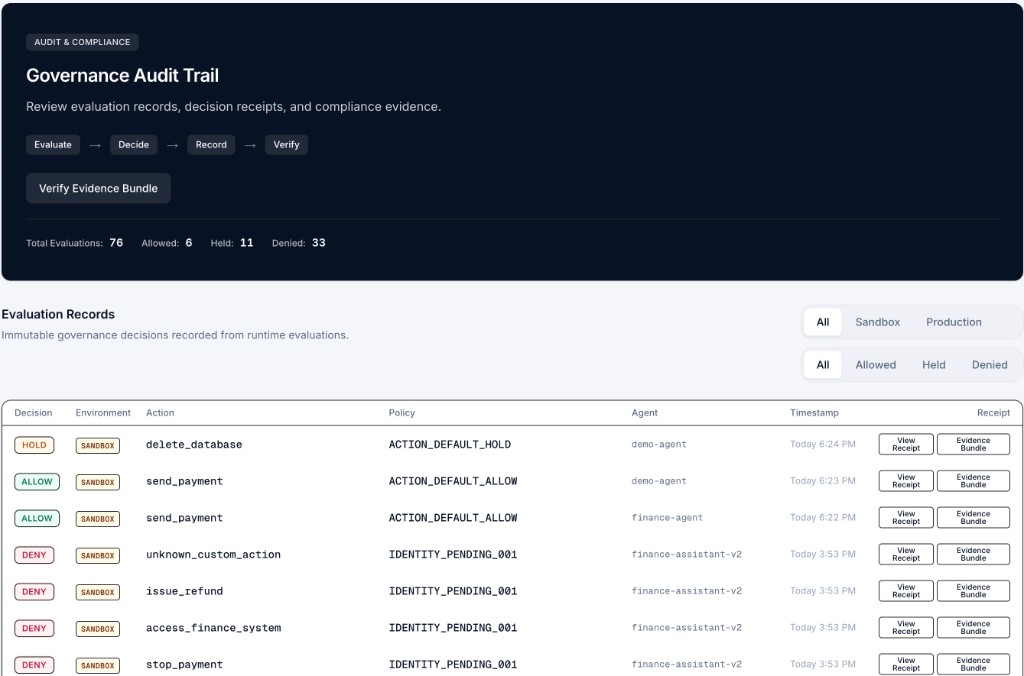
Arbiter is the Control Plane for AI Agents. Every action reaches Arbiter before production: Allow, Hold, or Deny. Humans approve when required, and every decision becomes audit evidence.
Works with the AI agent frameworks you already use
Keep your frameworks. Connect through MCP, SDK, CLI, or API.
Select the path that matches how you're integrating Arbiter today.
Recommended
Own AI agents
For OpenAI Agents SDK, LangGraph, CrewAI, and custom Node or Python runtimes. Mastra and AutoGen are detected automatically; use the generic Connect path. Install the CLI, then run Authority Connect in your project.
$ npm install -g @arbiterhq/cli $ arbiter login$ arbiter connect$ arbiter connect --applyExisting MCP servers
Govern existing MCP servers with minimal changes. Purpose-built for MCP.
$ npm install -g @arbiterhq/gate $ arbiter-gate --agent my-agent -- node ./mcp-server.mjsThe risk
Payments, infra changes, customer data: without a shared stop before execution, you find out after the damage.
Happening now
Sends a $50,000 payment
Happening now
Deletes a production database
You need a stop before execution, not another policy buried inside each agent.
Proof
A $5,000 payment request. Arbiter holds it. A human decides. The receipt is permanent.
AgentActionEvaluateHoldApprovalAudit
Governance Flow
Paused
Agent Identity
finance-agent
Autonomous payment processing agent
Exploring manually. Auto-play resumes after a pause
How Arbiter works
Not a pile of tools. One path every action takes before it can touch production.
Arbiter knows which agent is acting, not just which model answered.
The agent asks to do something real: pay, delete, export, deploy.
Before anything executes: Allow, Hold, or Deny.
Hold pauses the action until a person authorizes it.
Only then can the action reach Stripe, GitHub, your DB, or your APIs.
You can explain every decision later, with a receipt, not a guess.
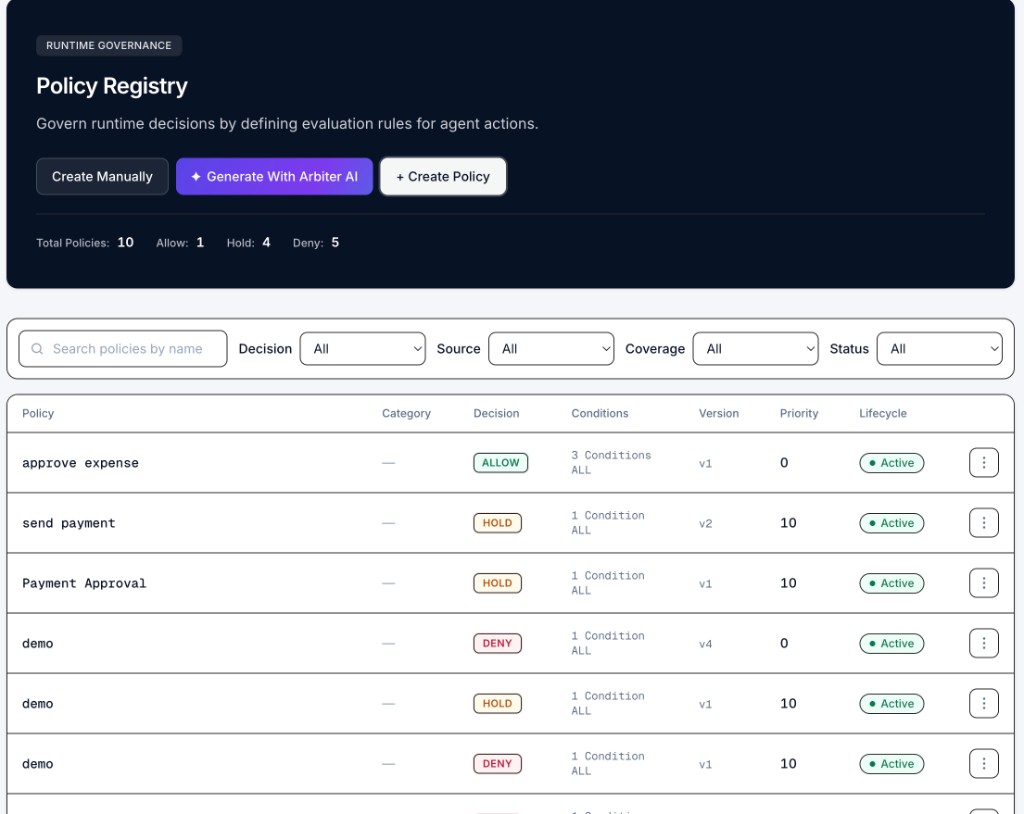
Permission: what the agent is authorized to access. Policy: the rules that decide whether each request is Allowed, Held, or Denied.
Connect your stack
Primary path for your own agent: Authority Connect (arbiter connect). Use the MCP Authority Gate for MCP clients. Use the SDK when you want evaluation inside your agent code.
Primary own-agent path. Run arbiter connect to configure and observe. Adopt in Discovery, then send an evaluation to verify governance. Connect does not rewrite your app or auto-Adopt.
For MCP-connected agents. Install the CLI, run arbiter connect --apply, and point your MCP client at the generated Gate wrapper. Gate (@arbiterhq/gate) ships with the CLI.
Advanced. Call ArbiterRuntime.evaluate() inside agent code when you own the evaluate boundary.
Evaluate, approve, and fetch audit evidence over HTTP when you need full control.
What you get
Five things between your agents and production. Nothing more to learn on the homepage.
Every agent has an identity you can authorize and revoke.
You define which actions each agent is allowed to ask for.
Allow, Hold, or Deny. Decided before execution.
Sensitive actions wait for a person, with full context.
A receipt for every decision. Not a chat log guess.
We asked developers, founders, security engineers, and enterprise reviewers to challenge Arbiter. Here's what they said, and what we're fixing.
What early developers are saying
“From sign up to a real ₹5,000 approval flow in under 30 minutes—with zero prior knowledge—was genuinely impressive. The AI policy generator was the cherry on top.”
Khushi
Early Reviewer · LinkedIn
“The SDK integration was straightforward. A centralized place for agent governance—without changing application code—is a strong concept.”
Harshit
Developer · LinkedIn
“Decoupling identity, authorization, policy evaluation, approvals, and auditing into an external control plane makes the architecture more modular and secure.”
Misbah Ullah
Co-founder, GADIS · LinkedIn
“A very thorough governance system with clear separation between different parts of the workflow.”
Ryan Gormican
Product Reviewer · LinkedIn
“'Without changing code or redeploying them' is the reason a busy team would even try you.”
Dima
Founder, NoCrash · LinkedIn
“A dedicated security gateway adds an independent layer of control before agent actions reach production systems.”
Deekshitha
Security Reviewer · LinkedIn
“The vision is compelling. The positioning and architecture are clear.”
Phani
Founder, Zyvora · LinkedIn
“The Allow / Hold / Deny model and the incident examples immediately make the problem obvious.”
Jogeeswara
Founder, JAgents Labs · LinkedIn
“Arbiter shows a strong, coherent approach to AI agent governance—with clear technical direction and enterprise-oriented thinking.”
Bruno Baumgartner
Founder, DigiEmu · Direct Outreach
We're listening. Here's what we're fixing
We heard
“Too much to grasp at first. I didn't find enough code snippets to understand how it works.”
Divakar
AI Developer · LinkedIn
Improving
We heard
“Onboarding was confusing. Errors like identity_pending_review didn't tell me what to do next.”
Harshit
Developer · LinkedIn
Improving
We heard
“The landing page undersells the product. Terminology was confusing and sections felt disconnected.”
Ryan Gormican
Product Reviewer · LinkedIn
Fixed
We heard
“You lead with the category, not the fear. Policy Registry and Permission Registry sound like the same thing.”
Dima
Founder, NoCrash · LinkedIn
Fixed
We heard
“The dashboard immediately shows setup errors. There's no guided demo mode.”
Abdul
Technical Reviewer · LinkedIn
Improving
We're an early-stage company. Trust comes from listening to developers, shipping improvements, and being transparent about what's still being built, not from pretending the product is perfect.
We work directly with a small set of teams shipping agents to production. Early access, founder and engineering support, and real influence on what ships next.
Tell us how your agents reach production. We'll respond personally.